About Shri Kantha Jilla
Modi Samaj
25+ years of uniting the Modi community of North Gujarat through faith, culture, education, and social welfare.
A community rooted in heritage, growing in unity
Shri Kantha Jilla Modi Samaj (SKJMS) is a registered community organisation serving the Modi community of the Kantha region of North Gujarat — the historic riverbank belt that has been home to our families for generations. Our roots as the Patanwala Modi community stretch back well over a century, with organised gatherings at Modhera that brought together villages from across the region.
After decades of community effort, elders from over 100 villages came together in the 1960s to revive the samaj. That effort culminated in the formal establishment of Shri Kantha Jilla Modi Samaj in November 1975 (Vikram Samvat 2031), with seven dedicated pioneers laying the foundation for what would become one of the most organised Modi community bodies in North Gujarat.
Today, SKJMS represents over 2,500 families and 10,000+ individuals across 22 divisions. Our work spans religious programs, educational support, matrimonial initiatives, social welfare, and cultural preservation — all anchored in our devotion to Shri Modheshwari Mata, our Kuldevi.
Our principal community centre — Shri Modheshwari Sankul in Pethapur, Gandhinagar — serves as the hub for community events, religious gatherings, cultural celebrations, and social programs throughout the year.
- Founded
1975
50+ years of service
- Region
Kantha
North Gujarat
- Families
2,500+
Registered members
- Centre
Pethapur
Gandhinagar, Gujarat
"A digitally connected, culturally strong, and united Modi community, preserving our heritage for generations to come."
The Rich History of Shri Kantha Jilla Modi Samaj
A proud saga of nearly 140 years of historical heritage
Our Roots: Dharmaranya and the Modh Identity
A glimpse of our community's origin is found in the 'Dharmaranya Purana', composed in the 14th–15th century. In ancient times, this region of North Gujarat was known as 'Dharmaranya'. According to legend, after slaying Ravana, Lord Rama performed a yagna on this land to atone for his sin. To protect dharma and trade on this sacred land, the 'Modh' Brahmins and 'Modh' Vaishyas — our ancestors — came into being. The place was known as 'Moherakpur', which in time became 'Modhera'.
During the Chaulukya (Solanki) dynasty (10th–13th century), Modhera became western India's most prosperous centre of trade and religion. All who settled here came to be known as 'Modh'. It was during this same period that the worship of Shri Modheshwari Mata (an incarnation of Mata Parvati) began — she remains our community's Kuldevi to this day.
Historical Migration and the Birth of the 'Modi' Surname
In 1297–1298 CE, the invasion of Alauddin Khilji of the Delhi Sultanate caused heavy damage to Modhera's temples and town. To save their faith, family, and livelihood, our ancestors left Modhera with heavy hearts. Some families moved to Patan–Banaskantha, while our ancestors moved on toward the Sabarmati, Hathmati, and Mahi river regions.
In these 'Kantha' regions of Mahi Kantha and Sabar Kantha (the princely states of Idar, Mansa, Pethapur, and others), our ancestors once again took up the grain and grocery trade. Merchants who supplied grain, oil, and daily provisions came to be called 'Modi' in the local language. Over time, this professional identity became our surname — the 'Modh' of Modhera and the 'Modi' of the trade came together to form the 'Modi Samaj'.
Origin and Historical Background
Nearly 140 years ago, the entire Modi Samaj of Gujarat was one large, organised body known as the 'Panch'. At a historic gathering held at Modhera, in view of the limits of transport and geographical distance, it was unanimously decided to split into two divisions. The area west of Mehsana came to exist as the 'Patanwala Modi Samaj', and the area to the east as 'Shri Kantha Jilla Modi Samaj'.
Early Structure and the Panch System
In its early stage, the samaj was divided into 15 main divisions — Himatnagar, Navagam, Pethapur, Pedhamli, Vijapur, Mansa, Aglod, Ladol, Nardipur, Ilol, Prantij, Sadra, Visnagar, Mehsana, and Soja-Jamla. Through this Panch system, the enormous task of eliminating social ills, framing rules and policies, and amicably resolving disputes continued without pause for 11.5 years.
Reorganisation of the Samaj and a New Direction
After 1946, the Panch system fell inactive for certain reasons. But after Vikram Samvat 2022, more than 100 active members of the samaj took up the task of reorganising it, holding meetings at Bahucharaji and Khedbrahma. It was decided to give every village representation, and new life was breathed into the samaj.
The Formal Establishment of Shri Kantha Jilla Modi Samaj
As a result of the tireless effort of the samaj's leaders and door-to-door personal outreach, the samaj was formally established in November 1975 (Vikram Samvat 2031). The guidance of seven founding pioneer members was invaluable to this establishment.
At the time of establishment, leadership was held through the post of 'Mahamantri' (General Secretary). Shri Ramlal Vitthaldas Modi (first), Dr. Ambalal Nathalal Modi (second), and Shri Natwarlal Amtharam Modi (third) — all three rendered outstanding service in the early years.
Establishment of the Trust and the Journey of Growth
In 1985, with the approval of the Charity Commissioner, the 'Shri Kantha Jilla Modi Samaj Trust' was established. The Trust raised funds and gave momentum to the samaj's development work. Through the combined efforts of many donors, elders, and young volunteers, the samaj has achieved numerous milestones in education, social welfare, and infrastructure development.
May the samaj continue to scale ever-greater heights of progress in the future — this is our prayer to Modheshwari Mata.
Founding Members
- Shri Shankarlal Nathalal ModiPedhamli
- Shri Amtharam Nathalal ModiGozaria
- Shri Shivlal Valchanddas ModiSadra
- Shri Manilal Jivramdas ModiMehsana
- Shri Vitthaldas Kacharalal ModiPethapur
- Shri Ramlal Vitthaldas ModiNardipur
- Shri Punjiram Nathalal ModiNardipur
Samaj Presidents
Shri Narayandas Ambalal Chhabda
Mehsana
Shri Ramlal Vitthaldas Modi
Nardipur
Shri Mukeshkumar Fulchanddas Modi
Mehsana
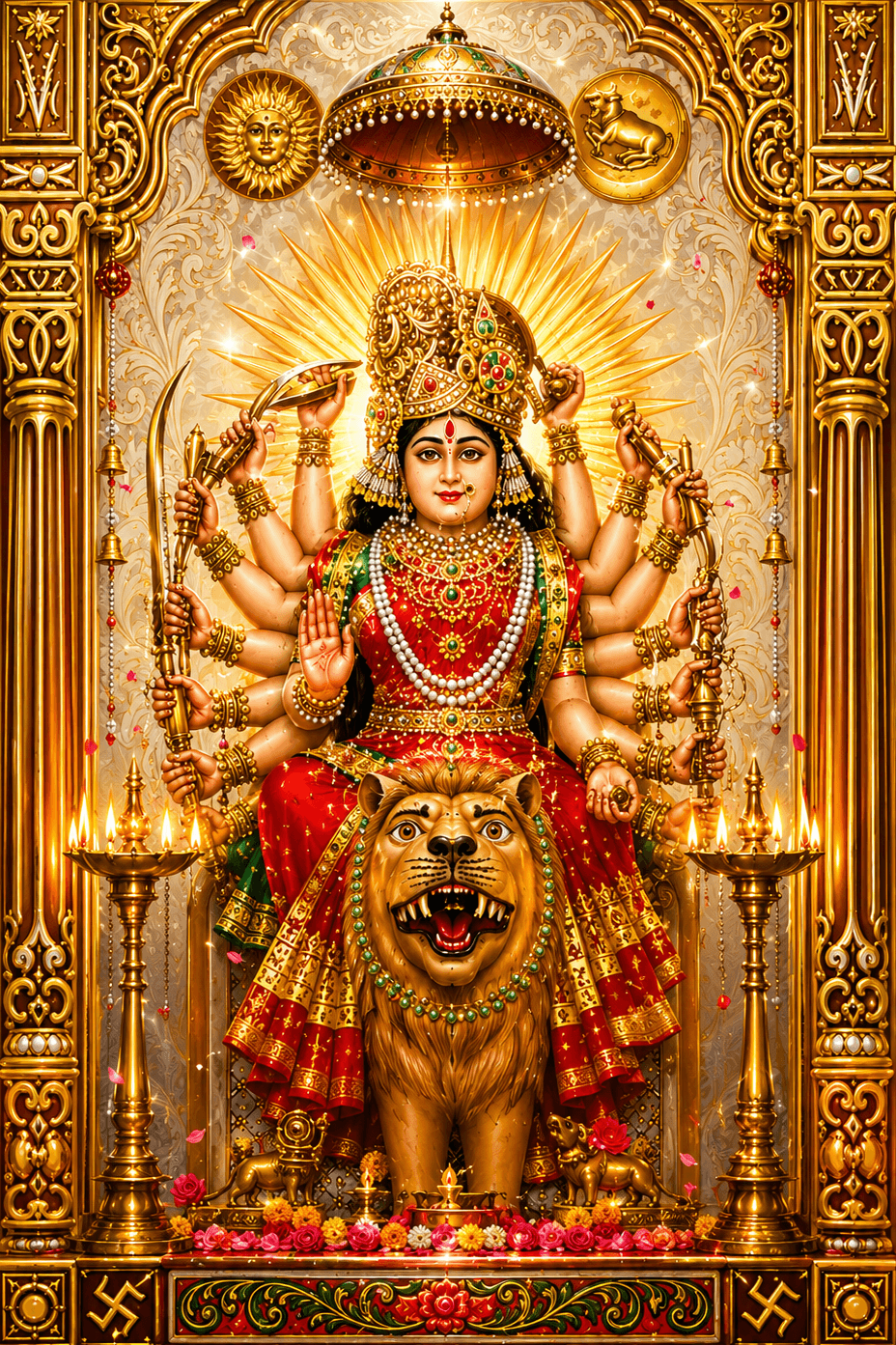
શ્રી મોઢેશ્વરી માતાજી
ૐ મોઢેશ્વરી માતાયૈ નમઃ ૐ
Shri Modheshwari Mata, our Kuldevi
ૐ મોઢેશ્વરી માતાયૈ નમઃ ૐ
Our community's history is a sacred saga of dharma, faith, valour, and indomitable courage. The 'Dharmaranya Purana', composed in the 14th–15th century, contains a detailed account of the manifestation of our Kuldevi Shri Modheshwari Mata and the origin of our community.
1. Dharmaranya and Lord Shri Rama
In ancient times, this region of North Gujarat (present-day Modhera and its surroundings) was known as 'Dharmaranya' — a land of penance for sages, Brahmins, and dharma-loving Vaishyas. According to legend, after slaying Ravana, on the instruction of Guru Vashishtha, Lord Shri Rama came to this Dharmaranya pilgrimage site to atone for the sin of 'Brahmahatya', performed a yagna, and bathed in its sacred waters to attain freedom from sin.
2. The Demon Karnat and the Sages' Great Yagna
In time, a cruel demon named Karnat attacked Dharmaranya — disrupting yagnas and tormenting the sages and people. When the suffering became unbearable, the Brahmins and people of Dharmaranya took refuge in the Trideva (Brahma, Vishnu, Mahesh) and, with deep devotion, invoked Mata Parvati, the primordial power and mother of the universe.
3. The Divine Manifestation from the Sacred Fire
Hearing the anguished cries of her devotees, Mata Parvati assumed an intensely fierce and radiant form — eighteen arms, each bearing a divine weapon: trident, sword, conch, discus, bow and arrow, and more. Seated upon a lion, blazing with the fire of wrath, the great power (Mahashakti) manifested from the sacred fire of the yagna. After a fierce battle, she slew the demon Karnat with her trident and sword, freeing Dharmaranya of its sin.
4. The Dharmaranya Vav and the Blessing of the Protector
To cleanse her weapons of the demon's blood (astrashuddhi), Mata used the sacred waters of the Dharmaranya Vav (stepwell). By her divine touch, this stepwell became miraculous and sacred; even today its consecrated water holds religious significance for devotees. Mata then blessed her devotees with a boon —
"Live fearlessly on this land. I shall protect you forever, and shall be worshipped as your Kuldevi."
Having manifested in Dharmaranya, Mata became renowned across the world as 'Shri Modheshwari Mata' — and remains our community's Kuldevi to this day.
Salutations at Mata's feet — may the samaj forever progress on the path of unity, education, and cultural values.🙏
Our 22 Divisions
SKJMS represents 22 distinct divisions (vibhags) of the Kantha region, each a unique part of our community's identity. When the samaj was first established in 1975, it was built on the foundation of 15 original vibhags — today that number has grown to 22, reflecting the community's continued expansion and unity.
- Ahmedabadઅમદાવાદ
- Mahesanaમહેસાણા
- Navgamનવગામ
- Soja Jamlaસોજા જામળા
- Prantijપ્રાંતિજ
- Himmatnagarહિંમતનગર
- Nardipurનારદીપુર
- Vijapurવિજાપુર
- Visnagar-1વિસનગર-૧
- Visnagar-2વિસનગર-૨
- Pethapurપેથાપુર
- Mansaમાણસા
- Tajpuriતાજપુરી
- Ilolઇલોલ
- Ladolલાડોલ
- Talodતલોદ
- Sadraસાદરા
- Kherwaખેરવા
- Siddhpurસિદ્ધપુર
- Aaglodઆગલોડ
- Gandhinagarગાંધીનગર
- Pedhamaliપેઢામલી
Not yet a registered member?
Join the SKJMS family. Register yourself and your household in our digital census and stay connected with every family in the community.
Register Now